

Events Interface
INFO
The Events Interface is implemented in PX4 and QGroundControl.
The Events Interface is a generic and flexible mechanism that allows one component to reliably notify a GCS (or any other component) of sporadic events and state changes. For example, the interface might be used notifying of arming readiness, calibration completion, and reaching the target takeoff height.
The interface provides for both common events that are shared by flight stacks or other components, and events that are specific to an implementation. MAVLink "common" events are defined in mavlink/libevents/events/common.json.
INFO
The events interface is intended to replace the widespread use of STATUSTEXT messages.
Key features
The following key features are provided by the interface:
- Reliable delivery with retransmission.
- Consistent interface to report system health and arming checks.
- Minimized buffer requirements on the autopilot side.
- Minimized binary message length.
- Generic: autopilot- and GCS-agnostic.
- Long-term stable and extensible.
- Allows arguments to be attached to an event.
- Possible types:
uint8,int8,uint16,int16,uint32,int32,int64,uint64,float. - Enums and bit fields can be built on top of these types
- Enable automated processing (for example from a flight log containing events).
- Minimize amount of auto-generated code for embedded implementations.
- Events volume of <1 Hz on average (may scale with protocol parameters adjustments, like retransmission timeouts).
- Events can be targeted or broadcast
- Any component can send events, including cameras, companion computers, ground stations, etc.
- Events have metadata, like a log level. They can also have a detailed, more extensive description, possibly with URLs.
- Support for message text and message translation.
Message/Enum Summary
Messages
| Message | Description |
|---|---|
| EVENT | Event message. Each new event from a particular component gets a new sequence number. The same message might be sent multiple times if (re-)requested. Most events are broadcast, some can be specific to a target component (as receivers keep track of the sequence for missed events, all events need to be broadcast. Thus we use destination_component instead of target_component). |
| CURRENT_EVENT_SEQUENCE | Regular broadcast for the current latest event sequence number for a component. This is used to check for dropped events. |
| REQUEST_EVENT | Request one or more events to be (re-)sent. If first_sequence==last_sequence, only a single event is requested. Note that first_sequencecan be larger thanlast_sequence (because the sequence number can wrap). Each sequence will trigger an EVENT or RESPONSE_EVENT_ERROR response. |
| RESPONSE_EVENT_ERROR | Response to a REQUEST_EVENT if there is an error requesting an event, including the reason. The most common reason would be that the event is not longer available (has been discarded). |
Enums
| Enum | Description |
|---|---|
| MAV_EVENT_CURRENT_SEQUENCE_FLAGS | Flags for CURRENT_EVENT_SEQUENCE. For example, to indicate when the sequence has reset. |
| MAV_EVENT_ERROR_REASON | Reasons for an error, as provided in RESPONSE_EVENT_ERROR. For example, common error would be that the event is not available (i.e. it has been discarded). |
Event Definitions and Metadata
Each event is identified by a 32-bit ID (EVENT.id). The most significant 8 bits are the component ID of the namespace that defines the event (typically the MAVLink component ID of the sender), and the lower 24 bits identify the event within that namespace. Events shared by multiple flight stacks and components are defined in the libevents common namespace (common.json).
The EVENT message only contains the event ID, a timestamp, the log levels, and the event arguments. All other information about the event, such as its name, message text, description, and argument types, is defined in JSON metadata that conforms to the libevents schema. A receiver fetches this metadata, and combines it with the event ID and arguments in order to display or process the event. As the metadata is not in the message, the event text can be translated, and can be much longer than would fit in a STATUSTEXT.
INFO
The Component Metadata Protocol (COMP_METADATA_TYPE_EVENTS) should be used to get the metadata. This ensures the event ids and their metadata are kept synchronised.
The metadata for each event includes:
- A short, single-line message, and an optional longer description. These may contain argument placeholders, URLs, and parameter links (see the libevents README for the format).
- Arguments. Valid types are:
uint8_t,int8_t,uint16_t,int16_t,uint32_t,int32_t,uint64_t,int64_tandfloat, and enums and bitmasks based on the integer types. Arguments are serialized into EVENT.arguments in the order they are defined, in little-endian byte order and without padding, up to a total of 40 bytes. - A group, which a GCS can use to handle a set of events differently. Groups include
default,calibration,healthandarming_check. A GCS should not display events from groups that it does not recognise.
Each event has two log levels, which are sent in EVENT.log_levels: an external log level (4 least significant bits) that is used by a GCS, and an internal log level (4 most significant bits) that is used for logging. The values are the same as MAV_SEVERITY, with the addition of Protocol (8) for events that should not be displayed to users, and Disabled (9).
Sending Events
A component that sends events must:
Assign each new event the next sequence number. The sequence number is a
uint16_tthat wraps back to 0 after 65535.Send each new event in an EVENT message. Events are usually broadcast (
destination_systemis 0 anddestination_componentis MAV_COMP_ID_ALL). An event can be addressed to a particular component by setting the destination fields, but other receivers still use its sequence number to detect lost events.TIP
EVENT uses
destination_systemanddestination_componentfor addressing, instead of the usualtarget_system/target_componentfields. This ensures thatEVENTmessages are routed as a broadcast message and that every receiver gets to see every event and can minimally process it to track the sequence number.Keep a buffer of the most recently sent events, so that they can be re-sent if requested.
Broadcast CURRENT_EVENT_SEQUENCE with the latest sequence number at a regular interval (nominally every 3 seconds). This allows receivers to detect lost events even if no new events are sent.
Set the MAV_EVENT_CURRENT_SEQUENCE_FLAGS_RESET flag in
CURRENT_EVENT_SEQUENCEif the sequence number has been reset (for example, after a reboot).Respond to a REQUEST_EVENT by handling each sequence number from
first_sequencetolast_sequence(the range may wrap):- If the event is still in the buffer, re-send it in an
EVENTmessage. - Otherwise, send a RESPONSE_EVENT_ERROR addressed to the requester, with
sequenceset to the requested sequence number,reasonset to MAV_EVENT_ERROR_REASON_UNAVAILABLE, andsequence_oldest_availableset to the oldest buffered sequence number after the requested one.
- If the event is still in the buffer, re-send it in an
The sender does not need to track receivers, or know whether an event has been received.
Receiving Events
A component that receives events tracks the latest received sequence number separately for each sender (system ID and component ID), and must:
- Initialise the latest received sequence number from the first
EVENTorCURRENT_EVENT_SEQUENCEreceived from the sender. - For each
EVENT:- If the sequence number is the next expected one, process the event and update the latest received sequence number.
- If the sequence number is older than the latest received, discard the event (it is a duplicate).
- If the sequence number is newer than the next expected one, events have been lost: request the missing events using
REQUEST_EVENT.
- For each
CURRENT_EVENT_SEQUENCE:- If
MAV_EVENT_CURRENT_SEQUENCE_FLAGS_RESETis set, discard the tracked sequence state and re-initialise the latest received sequence number from the message. - If the sequence number is newer than the latest received, request the missing events using
REQUEST_EVENT.
- If
- Re-send
REQUEST_EVENTif the requested events are not received within a timeout (nominally 100 ms). - On receiving a
RESPONSE_EVENT_ERRORfor a requested event, treat the events from the requested sequence up to (but not including)sequence_oldest_availableas lost, and continue fromsequence_oldest_available. - Only act on events where
destination_systemis 0 or its own system ID, anddestination_componentisMAV_COMP_ID_ALLor its own component ID.
All sequence number comparisons must handle wrap-around.
A receiver that has not yet downloaded the metadata for a sender can only identify events by ID. It should either queue events until the metadata is available, or discard them.
Sequences
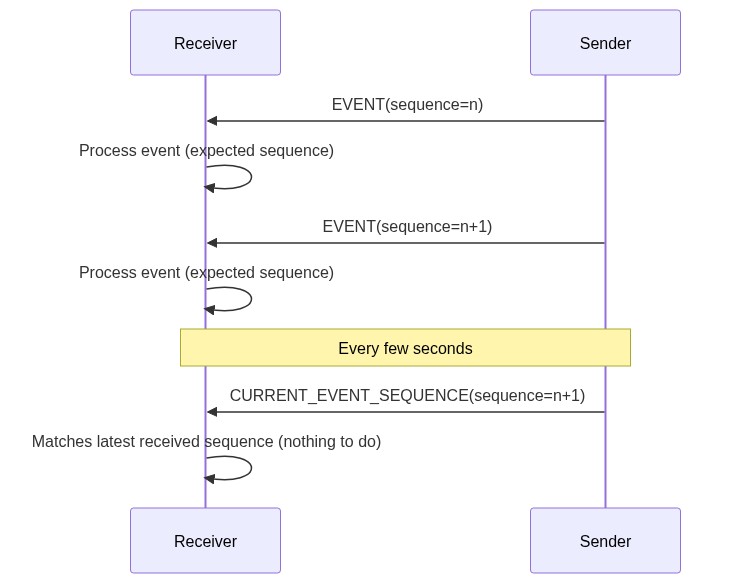
Event Delivery
The sender sends each new event with the next sequence number, and regularly broadcasts the latest sequence number.
Lost Events
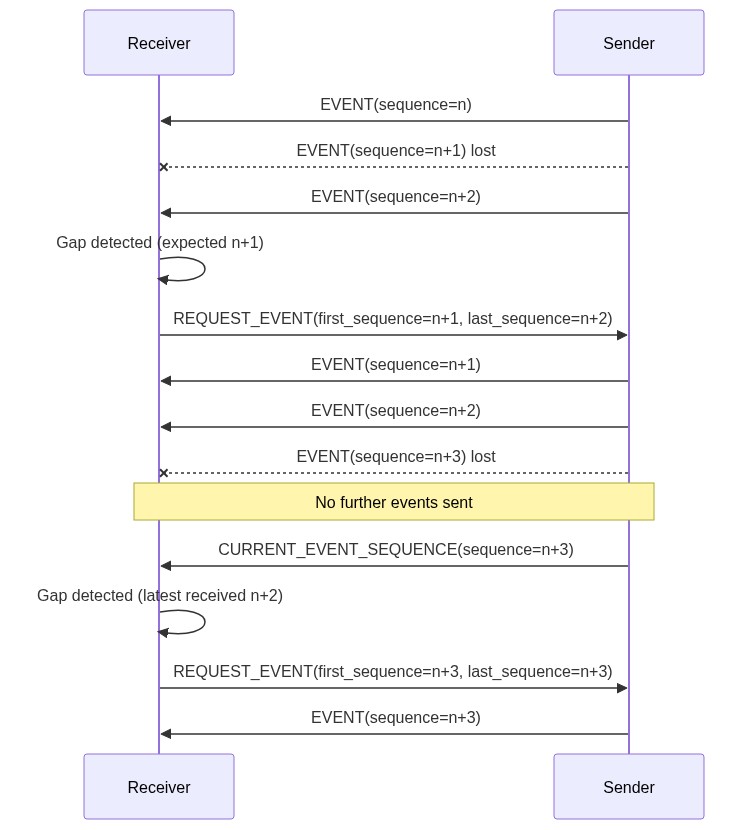
A receiver detects lost events from a gap in the sequence numbers of incoming events, or from CURRENT_EVENT_SEQUENCE (which is needed if the lost event was the last one sent). It requests the missing events with REQUEST_EVENT.
Requested Events Unavailable
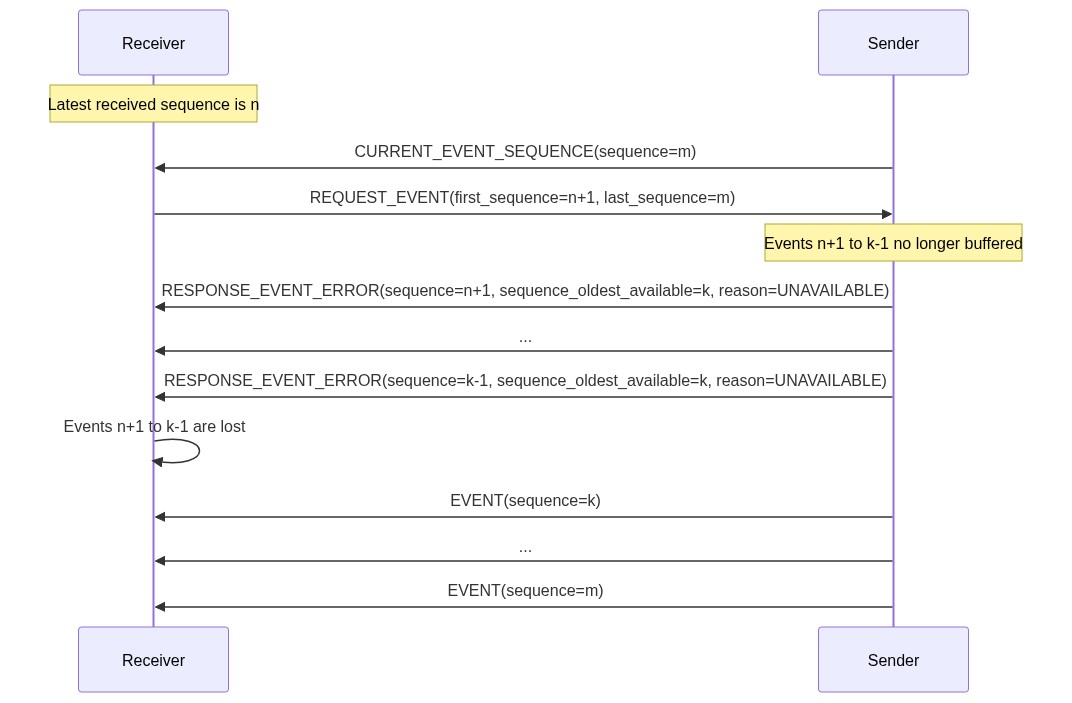
If a requested event is no longer buffered, the sender responds with RESPONSE_EVENT_ERROR. The receiver treats the events before sequence_oldest_available as lost, and continues from there.
Events Sub-Protocols
Sub-protocols can be layered over the events protocol in order to manage how certain types of events are presented and handled. A sub-protocol defines:
- The event groups that it uses.
- The meaning of particular event types within those groups (such as
summary), and the order in which events are sent. - Any required event arguments or constraints (for example enums that a component must define in its events metadata).
A component indicates that it supports a sub-protocol by listing it in the supported_protocols of its events metadata. A receiver should only use a sub-protocol if the sender lists it, and can ignore events in the groups of sub-protocols that it does not implement.
Only the health and arming checks sub-protocol is currently implemented.
Health and Arming Checks
The events interface is used to report the health of vehicle subsystems and the results of arming checks. A GCS can use this report to show the state of each subsystem (for example, a GPS indicator), to enable UI actions such as arming or starting a mission, and to list the problems that need to be fixed (with a detailed explanation for each).
Health problems are those that require maintenance or repair of the vehicle, such as a failed sensor. Arming check problems are conditions that prevent arming, and which can usually be fixed in the field, such as having no GPS fix or requiring sensor calibration.
A component that supports this sub-protocol lists health_and_arming_check in the supported_protocols of its events metadata. The metadata also defines two bitmask enums that are used by the report:
- Health components: one bit for each subsystem or sensor. The first bit must be "none".
- Navigation mode groups: one bit for each group of flight modes that share the same arming checks. The metadata
navigation_mode_groupsmaps each group to the MAVLink custom modes that it contains.
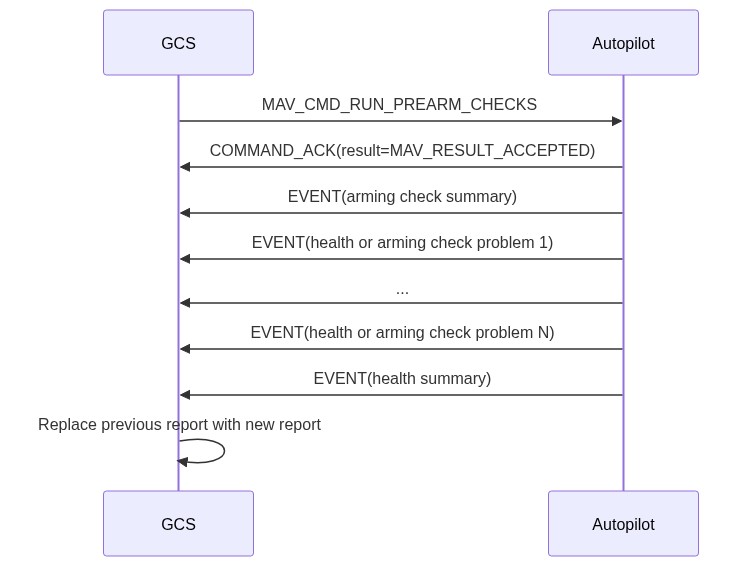
A report consists of the following events, sent in order:
- Arming check summary (group
arming_check, typesummary), with arguments:chunk_idx: Index of the chunk (a report can be split into multiple chunks that the receiver combines).error,warning: Health components that have arming check errors or warnings.can_arm: Navigation mode groups in which the vehicle can be armed.can_run: Navigation mode groups that the vehicle can switch to while armed.
- Zero or more events for individual problems (group
healthorarming_check). The first two arguments of each event are:- The navigation mode groups that are affected by the problem (bitmask).
- The index of the affected health component (0 if none applies).
- Health summary (group
health, typesummary), with arguments:chunk_idx: Index of the chunk.is_present,error,warning: Health components that are present, that have errors, and that have warnings.
The sender sends a new report whenever the results change, and when it receives MAV_CMD_RUN_PREARM_CHECKS. A receiver replaces its current report when it receives a complete new report, and should discard a partial report if events are lost.
Events of type append_health_and_arming_messages take a custom mode as their first argument. A GCS displays the message of such an event followed by the current problems for that mode (for example, to explain why arming or a mode switch was denied).
Limitations
- Event arguments cannot be strings, arrays, or
doublevalues. - A receiver cannot display an event for which it does not have metadata (only the event ID is known).
- A sender does not know whether or when an event has been received.
Implementations
Implementation PRs and other information is listed below.
- libevents: C++ and Python library for receiving events, parsing events with their metadata, and handling health and arming check reports. It also contains the common event definitions and the metadata schema.
- The libevents tooling limits event arguments to 25 bytes (to reduce sender buffer requirements), which is less than the 40 bytes allowed by
EVENT(config.ini). - receive.h implements the receiving side of the protocol. It requests one event at a time (
first_sequenceequal tolast_sequence), re-requests after a timeout of 100 ms, and discards an event that arrives out of order (the event is re-requested later). It also treats a large backwards jump inevent_time_boot_msas a sender reboot, in case the reset flag was missed. - health_and_arming_checks.h implements the receiving side of the health and arming checks report.
- The libevents tooling limits event arguments to 25 bytes (to reduce sender buffer requirements), which is less than the 40 bytes allowed by
- QGroundControl
- PR: Events interface (first iteration) #9217
- Source: src/MAVLink/LibEvents
- QGroundControl sends
MAV_CMD_RUN_PREARM_CHECKSafter it has loaded the events metadata for the vehicle, in order to get a health and arming checks report (Vehicle.cc).
- PX4:
- Events Interface (docs)
- PR: Events interface #16293
- Source: src/modules/mavlink/mavlink_events.cpp
- PX4 buffers the 20 most recent events, and sends
CURRENT_EVENT_SEQUENCEevery 3 seconds (mavlink_events.h, mavlink_events.cpp). - PX4 sends a health and arming checks report when the results change and when it receives
MAV_CMD_RUN_PREARM_CHECKS(Commander.cpp, HealthAndArmingChecks/Common.cpp). - PX4 also sends each event as a
STATUSTEXTthat ends with a tab character, for GCSs that do not support events. QGroundControl ignores these messages from PX4 (Vehicle.cc). - MAVSDK events plugin